New research suggests climate change will cause humans to move in unprecedented numbers. The Times Magazine partnered with ProPublica and data scientists to understand how.
“I’m Usually a Conflict Photographer. Now, I’m Documenting My Family. For the first time in my career I decided not to cover a major event. I’m seeing something more timeless and universal.”
“Every Western institution was unprepared for the coronavirus pandemic, despite many prior warnings. This monumental failure of institutional effectiveness will reverberate for the rest of the decade, but it’s not too early to ask why, and what we need to do about it.”
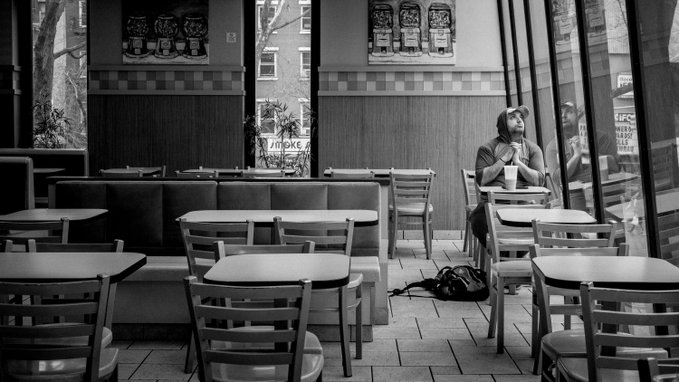
“New York was still making money a week ago. A few people wearing masks, some closings, but generally business as usual. And then we tumbled down a cliff. By Friday, commuters arriving at Grand Central Terminal paused as they entered the main concourse — stunned by its emptiness, the usual din quieted by stay-at-home orders from companies and the government. For the first time, the vast, star-covered ceiling seemed appropriate.
Earlier this month, I started to travel the city to document the onset of one type of economic activity — the anxious purchase of emergency supplies — and the collapse of many, many others.”
A fast-food restaurant last Thursday in downtown Manhattan was nearly empty. Photographs and Text by Ashley Gilbertson
“Picture yourself at a college graduation day, with a fresh cohort of students about to set sail for new horizons. What are they thinking while they throw their caps in the air? What is it with this thin sheet of paper that makes it so precious? It’s not only the proof of acquired knowledge but plays into the reputation game of where you were trained. Being a graduate from Harvard Law School carries that extra glitz, doesn’t it? Yet take a closer look, and the diploma is the perfect ending to the modern tragedy of education.”
“Imagine the following. You are living a life with enough money and health and time so as to allow an hour or two of careless relaxation, sitting on the sofa at the end of the day in front of a large television, half-heartedly watching a documentary about solar energy with a glass of wine and scrolling through your phone. You happen to hear a fact about climate change, something to do with recent emission figures. Now, on that same night, a friend who is struggling to meet her financial commitments has just arrived at her second job and misses out on the documentary (and the relaxation). Later in the week, when the two of you meet for a drink and your friend is ignorant of recent emission figures, what kind of intellectual or moral superiority is really justified on your part?”
“Thousands of companies around the world have been certified as B Corps, solidifying their commitment to public good in their corporate charters and undergoing a rigorous audit. But can the nascent B Corp movement scale?”







 casadetake.com